
What is the municipal register in Spain?
He municipal register It is the administrative register where all the residents of a municipality are recorded. It is regulated by Law 7/1985, of April 2, Regulating the Bases of the Local Government System, and its management is the responsibility of each City Council.
Every person residing in Spain, regardless of their nationality, legal status or type of permit, has both the right as well as obligation to register on the municipal register of the municipality where they usually live. This includes people in an irregular situation: Spanish law guarantees access to registration without requiring a residence permit.
Registration in the census generates the certificate of registration, A residence permit is an official document that certifies where and since when a person has resided in Spain. For foreigners, this certificate is not a simple formality: it is one of the most important documents in their entire immigration process.
Key fact: If you have been in Spain for more than 183 days a year, you are legally required to register, regardless of your administrative status.
Why is registering with the local council so important for foreigners?
Registering your address serves a dual purpose: it grants you access to basic services and, at the same time, generates the residency record you'll need for major immigration procedures. Let's examine both aspects in detail.
For immigration procedures
Registration is essential or fundamental in the following procedures:
Social integration: To apply for residency based on social integration, you need to prove a minimum period of residence in Spain (2 years according to the new Immigration Regulations of 2025, although historically 3 years were required). historical registration certificate This is the most compelling evidence presented to the Immigration Office. An application for residency based on social integration without continuous registration and without gaps in the registration period is highly likely to be denied.
Employment ties: Similarly, for residency based on employment, proof of two years of residence in Spain is required. While not the only form of proof, registration with the local council is the most reliable and leaves the least room for error for the authorities.
Family ties: Registration with the local council proves cohabitation in Spain and is necessary to demonstrate residence in the country with the family members who support the application.
Renewals of residence permits: In 2026, the new system will require proof of actual residence in Spain for more than 183 days per year. Registration on the municipal census is the most direct and reliable proof.
Extraordinary regularization 2026: The government has enabled an extraordinary regularization process with a deadline of June 30, 2026. The registration certificate is one of the most valued public documents to prove continuous residence in Spain from before January 1, 2026.
Long-term residence and Spanish nationality: To obtain permanent residence (5 years) or Spanish nationality by residence (10 years in general, 2 for Latin Americans), the registration history is essential to demonstrate continuity of residence.
For access to basic services
Being registered is a requirement or necessary condition for:
- Health card: Accessing the Spanish public healthcare system and being assigned to a health center
- Education: Enrolling children in the public school or institute of the municipality
- Social aid and benefits: Apply for the minimum living income, regional insertion income, scholarships or emergency aid
- Documentation: In many cases, renewing the NIE or processing the TIE requires providing an updated registration certificate
- Municipal services: Access to libraries, municipal sports facilities, discounted transport, etc.
- Banking and administrative procedures: Many financial institutions and public bodies require registration as proof of address
How to register in Spain: step by step
The process is simpler than it seems. Here are the steps:
1. Gather the necessary documentation
The documents you need to bring to the Town Hall are:
- Registration application form (provided by the City Council itself, also available on many municipal websites)
- Identity document: A valid passport, NIE, TIE, or other recognized identity document. Some municipalities also accept expired documents in justified cases.
- Address documentation, which may be one of the following:
- Current rental agreement (signed by landlord and tenant)
- Property deed
- Signed authorization from the contract holder or owner (if you live with another person), accompanied by their identity document
- In some municipalities, utility bills (electricity, water, gas) in the name of the homeowner are also accepted.
Important: If you are going to register your address at someone else's (friend, family member, acquaintance) address, you will need their written authorization and a copy of their ID card, NIE (Foreigner's Identity Number), or passport. This is a common and completely legal practice.
2. Request an appointment (if necessary)
Most city halls in medium and large cities require an appointment for registration. You can request one:
- Through the electronic headquarters of the City Council of your municipality
- By phone to the citizen service
- In person at the census offices or citizen service offices
In small municipalities it is usually possible to go directly without an appointment.
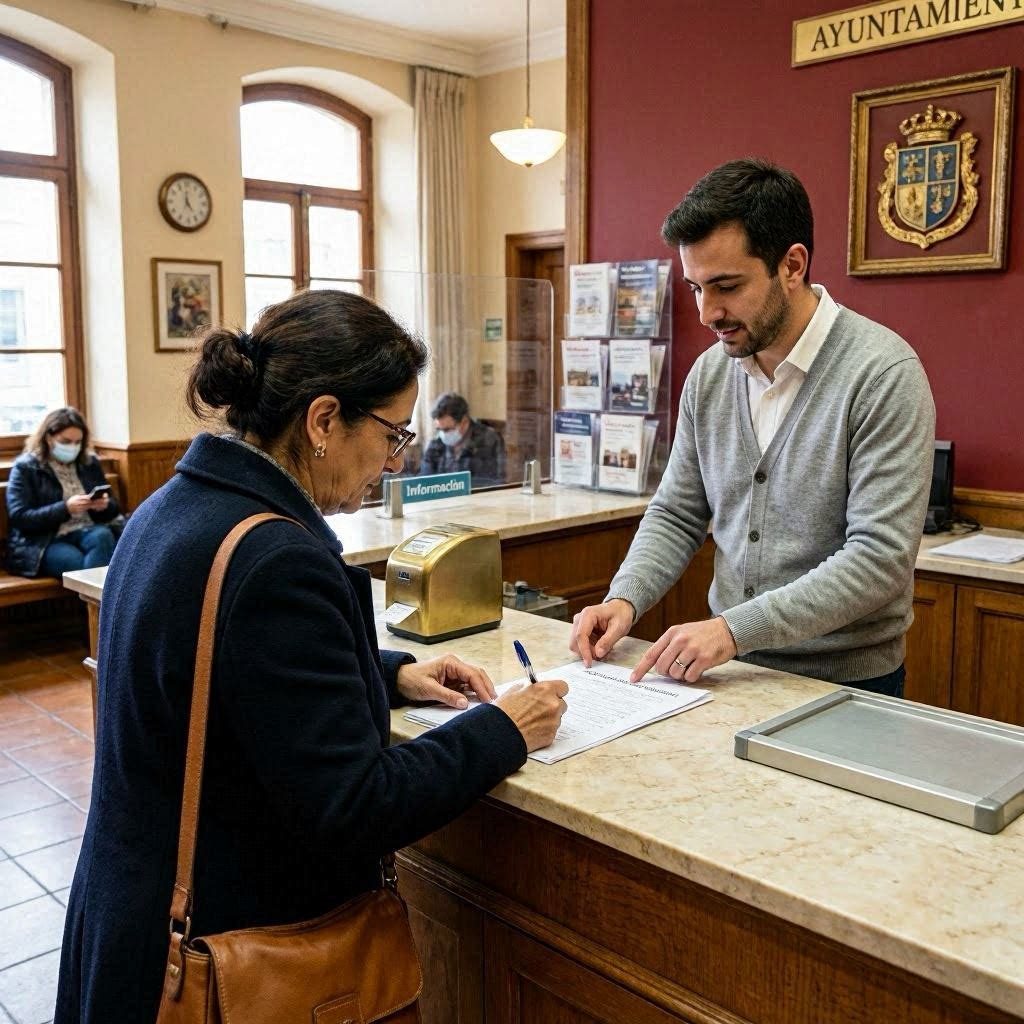
3. Go to the Town Hall and submit the application
Submit all the documents and sign the form. You will receive the results immediately or within a few days. registration form, This document confirms your current registration. The official registration certificate (with signature and seal) may take a few more days to be issued.
4. Notify changes of address
If you move to another municipality or to another address within the same municipality, you have the legal obligation to update your registration within a maximum period of 15 days. If you don't, you could lose continuity in your residency history, which can seriously affect a future application for residency based on roots or other immigration procedures.
Can I register my address without papers or in an irregular situation?
Yeah. This is one of the most frequently asked questions and the answer is clear: Spanish legislation It does not require any type of residence permit To register as a resident, the only requirement is to have an address in Spain and be able to provide some basic proof of it.
The Constitutional Court and the Supreme Court have repeatedly confirmed that access to the municipal register is a right of every person residing in Spain, regardless of their immigration status. Furthermore, register data is protected and cannot be shared with agencies such as the police or the Directorate General for Migration for the purpose of verifying the legal status of foreigners.
Therefore, if you are in an irregular situation, Registering your address as soon as possible is especially importantThis time registered will count towards future social integration, employment integration or other regularization processes.
Types of registration certificates and what each one is used for
Not all registration certificates are the same. These are the main ones:
Registration slip
This is the simplified and quickest version to obtain. It certifies that you are currently registered at a specific address. It is used for everyday procedures such as opening bank accounts, school registration, or applying for municipal services. In many town halls, it can be obtained immediately, even online.
Current registration certificate
An official document, signed and stamped by the City Council, that certifies current registration as a resident. It carries more weight than a certificate of residence and is required for more important administrative procedures. It typically takes between 2 and 10 business days to be issued.
Historical registration certificate
This is the document most important for immigration procedures. It includes all addresses and periods in which the person has been registered in Spain since their first registration, including changes of municipality.
It is essential for:
- Request the social, work or family ties
- Prove years of residence for the long-term residence
- Process the Spanish nationality by residence
- Any procedure where continuous residence in Spain must be demonstrated
How to apply: You must request it from the town hall where you are (or have been) registered as a resident. If you have lived in several municipalities, you will need the historical certificate from each one. Some town halls allow you to request it online using a digital certificate, the Cl@ve system, or an electronic ID card. It is free in most municipalities, although some may charge between €3 and €15. The processing time varies from immediate issuance to 10 business days.
Professional advice: Request your historical registration certificate several months in advance of submitting any residency application. This document is crucial and processing can take time, especially if you have lived in several municipalities. Make sure it has no gaps in your registration: any period without registration can be grounds for rejection.
Common mistakes you should avoid
These are the most common mistakes that can ruin your registration record:
Do not register from the first day: Every day that passes without being registered is time that will not count towards residency. If you arrive in Spain and take months to register, that initial period may not be easily proven by other means.
Not updating your registration when moving: If you move to a different apartment or city and don't update your registration, a temporary gap may appear in your historical certificate, complicating your residency application.
Requesting a historical certificate from only one municipality when you have lived in several: If you've moved cities, you need a historical certificate from each municipality where you've lived. Forgetting one can create inexplicable gaps in your record.
Do not keep intermediate registration forms: Although the historical certificate contains all the information, some organizations request documents from specific events. Keep everything.
Confusing the steering wheel with the historical certificate: These are different documents. For residency applications and other legal processes, you always need the historical certificate, not the current registration document.
Registration and extraordinary regularization 2026
The Spanish Government has launched a program in 2026 extraordinary regularization process This is for undocumented immigrants who can prove they arrived in Spain before January 1, 2026, and have resided in the country continuously for at least five months. The application period is now open. from April 16 to June 30, 2026, without extension.
In this process, the certificate of registration It is one of the most highly valued public documents for proving residency. Although other documents are also accepted (rental agreements, bills, medical appointments, transport passes), the registration certificate is the most reliable before the Administration because it comes from an official public registry.
If you believe you may qualify for this extraordinary regularization, contact us urgently: the deadline is very short and there will be no extension.
Frequently asked questions about registering your address in Spain
Can I register my address if I don't have a rental agreement in my name? Yes. You can register your address with an authorization signed by the contract holder or property owner, along with their ID. This is a very common and completely legal situation.
Does registering as a resident give me the right to work in Spain? No. Registration with the local council proves residency, but it does not grant any type of work authorization. To work legally, you need the corresponding work permit.
How long does it take to register me on the census? Generally, registration is effective from the moment you submit the application and the correct documentation, although the physical certificate may take a few days to be issued. The important thing is the application date, which will be your registration date.
Can they remove me from the register without my knowledge? Yes. Local councils can initiate deregistration proceedings if they verify that you no longer reside at that address, for example, following an inspection or a complaint from the landlord. That's why it's important to keep your registration up to date and renew it if the local council requests it.
Does registration replace the NIE? No. They are different documents with different functions. NIE It is your tax and administrative identification number with the Spanish Administration; the registration certificate proves your residence in a municipality. Both are necessary for different procedures.
What happens if I register as a resident but then leave Spain for several months? If you are absent from Spain for extended periods, you may lose the continuity of residence required for residency based on family ties. Generally, absences exceeding 120 days accumulated within the required residency period can break this continuity. Always consult with a specialist before taking long trips.
NIESPANA: We help you with registration and all your immigration procedures
Registering your address is just the first step in the process of obtaining your residence permit. This registration begins the process of building a record that, years later, will allow you to regularize your status, renew your permits, or apply for Spanish citizenship.
At NIESPANA we have been for more than 23 years old Helping foreigners navigate the Spanish immigration system. We know every procedure, every document, and every Immigration Office. We advise you from registering with the local council to obtaining permanent residency.
✅ Book your online consultation And begin your process with the confidence of having the best on your side.
Need to know more about residency permits? Check out our specialized pages:
Do you have any questions? Contact us and we'll get back to you in less than 24 hours.
Sources: Law 7/1985, of April 2, Regulating the Bases of the Local Regime; Royal Decree 1690/1986, of July 11 (Regulation of Population and Territorial Demarcation); Organic Law 4/2000, of January 11 (Law on Immigration); Royal Decree 1155/2024, of November 19 (Regulation on Immigration).